
New Tax Policy Book for Ordinary People to be Released Soon
Many people who read “The Rich Don’t Pay Tax! …Or Do They? — Second Edition – Revised and Expanded” have been anxiously awaiting the release of “The Tax Deception”. In fact, “The Tax Deception” was inspired largely by comments regarding the last section of the previous book.
Due to a number of unexpected factors, this book took much longer to write than originally planned. There was, of course, the virus that slowed everything down. I had it twice, though I’ve had worse colds. But there were other things that slowed down my writing. In particular, I started writing this book, with 13 goals for tax reform. But that number kept increasing, due to suggestions that I received from readers of “The Rich Don’t Pay Tax! …Or Do They?” As a result of those suggestions and certain changes in the economic climate, “The Tax Deception” is based on 22 goals for effective tax reform.
Those additional goals would take a lot of additional research. As I have always done in my writing, whenever I state something as a fact, unless it it common knowledge, I try to include a link to a reputable source. The result of all that research is that the number of footnotes included in this book has reached 74. But consider that, for every link provided in the footnotes, I probably read 10 to 20 articles, white-papers, and scholarly publications, to determine what needed to be included in the book.
But that was not the end of it. Just as I was getting started on this book, a dear friend, for whom my wife and I were “cancer buddies”, took a turn for the worse and we ended up getting to know the staff at M.D. Anderson Cancer Center very well. However, my writing justifiably proceeded at a snail’s pace for a couple of years and I do not regret that in the least.
Finally, add in the fact that we moved, in the middle of writing “The Tax Deception”. As much as I tried to keep writing, during that time, I found that it was just not possible to focus, on both the book and moving at the same time. By the time we got settled into our new home, I had to re-read what I had already written, since I didn’t want to repeat myself too much. I even had re-read some of the documents from my research, before I could get back into the flow. The difficult part is translating the economic technobabble into plain English and it takes time to get into that mode.
The ultimate result is that “The Tax Deception” is complete and being proofed at this time. I learned from my last book that proof-reading is not one-and-done. After I proof-read it once, I pass it off to others to proof. While that is going on I re-read it one-word-at-a-time. It’s amazing how many mistakes you can find that way. But the proofing technique that I find most surprising is reading the whole book backwards. It forces you to think about each word. Even after I and others had done our best, that method found five or six mistakes. Then I submitted it for printing and received a hard-copy proof.
As you can see from this photo, we found more issues, while reading the hard-copy.
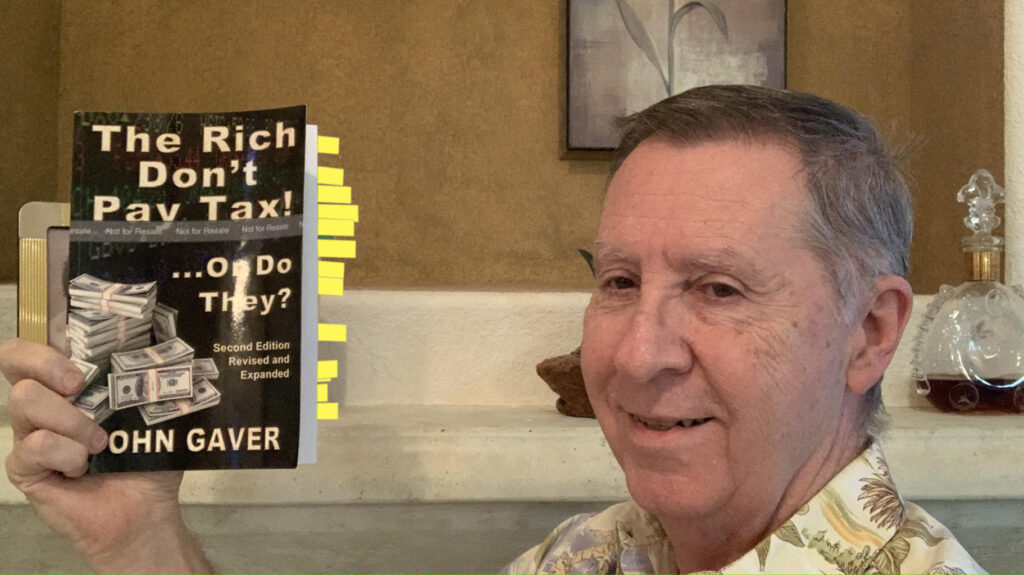
The short version is that proof-reading is almost as difficult as writing the book in the first place. Thankfully, it doesn’t take nearly as much time. The first proof-reading is done and I am in the process of reading it one-word-at-a-time. If it goes like the last book, I expect that it will be ready for release some time in mid to late January of 2024 or maybe as late as mid February.
Thanks to all of you who gave me ideas and thanks for waiting for longer than expected.
This book is a goals-based analysis of the progressive income tax (the problem) compared to an Ideal Flat Tax and the FAIRtax (H.R.25). To be fair, I also analyzed H.R.1040, which it the Flat Tax bill that is in Congress today, just so readers could contrast it with the best-case scenario Flat Tax.
For the record, it was my own use of this proven analysis technique that ultimately changed my mind on tax policy quite a number of years back. I’ve added more goals, since that first analysis. So when I began writing, I decided that I would share my findings with you. I touched on these points in “The Rich Don’t Pay Tax! …Or Do They?” But the focus of that book was different. “The Tax Deception” is all about this analysis.
As many readers of my earlier tax policy book pointed out, I don’t use incomprehensible econo-speak. Instead, I break it down into easily comprehensible chunks that are explained in ordinary every-day English. One of the reviewers of my last book put it this way.
“Author John Gaver has done a remarkable job of researching IRS tax data, collating it into easily-understood, conclusive evidence that the citizens of the U.S. have been duped (surprised?) into believing…”
I encourage you to not only read the book, but in particular, download the referenced IRS spreadsheets and follow any links regarding things that you may find to be almost too incredible. The truth is out there. Sometimes it is surprising. I’ve done my best to collate it into an easily understood volume. I hope you will find it of interest.
— John Gaver
Comments
New Tax Policy Book for Ordinary People to be Released Soon — No Comments
HTML tags allowed in your comment: <a href="" title=""> <abbr title=""> <acronym title=""> <b> <blockquote cite=""> <cite> <code> <del datetime=""> <em> <i> <q cite=""> <s> <strike> <strong>